For dimes and quarters the date settles it: 1964 and earlier is 90% silver, and 1965 and later circulation coins have no silver. Half dollars, dollars and nickels need an extra step: 1965-1970 Kennedy halves are 40% silver, and 1942-1945 nickels are 35% silver. This guide gives the cutoffs, the weight each silver coin should have, and a routine for sorting a jar or an inherited box.

The date cutoffs, denomination by denomination
The figures below come from the melt-value table published by the grading service NGC, retrieved 2026-11-09 (NGC coin melt values).
- Dimes: Mercury dimes (1916-1945) and Roosevelt dimes (1946-1964) are 90% silver. A Roosevelt dime dated 1965 or later is not on the silver list, unless it is a collector issue.
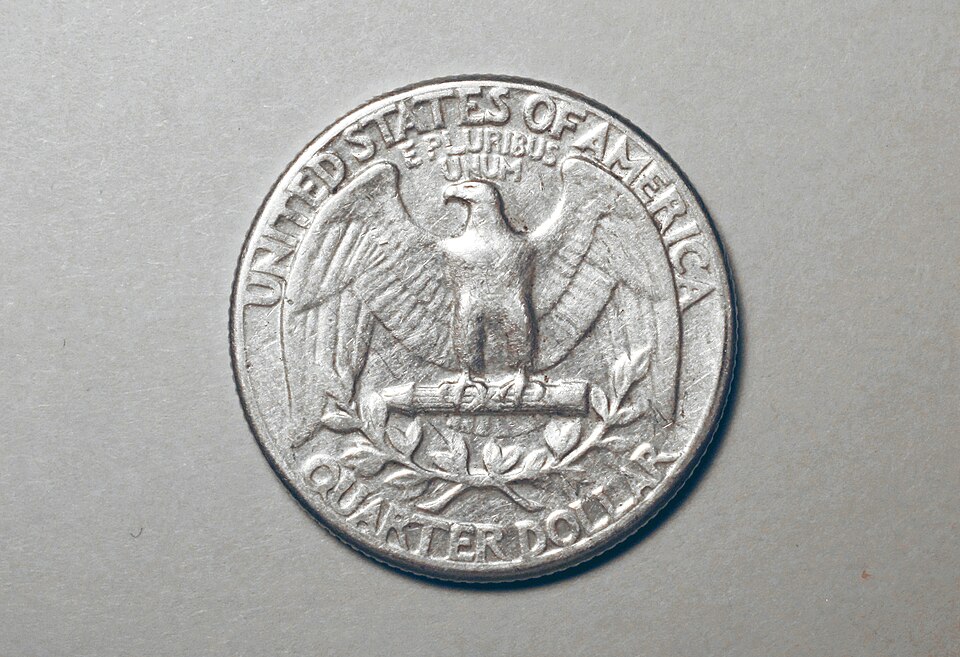
- Quarters: Washington quarters dated 1932 through 1964 are 90% silver. Later circulation quarters are not.
- Half dollars: Walking Liberty (1916-1947), Franklin (1948-1963) and the 1964 Kennedy are 90% silver. Kennedy halves dated 1965 through 1970 are only 40% silver, and NGC's list stops there.
- Dollars: Morgan (1878-1921) and Peace (1921-1935) dollars are 90% silver. Eisenhower dollars from circulation are not silver. Only the 1971-1976 silver version is, at 40%, and it was a collector issue; it is not what turns up in a jar.
- Nickels: Wartime Jefferson nickels, struck from October 1942 through 1945, are 35% silver. Turn the coin over and look for a large mint mark above Monticello; regular nickels have a small mark to the right of the building. A 1942 nickel without the large mark above Monticello is ordinary copper-nickel.
- Older and collector coins: Older dimes, quarters and half dollars (Barber, Standing Liberty, Seated Liberty) are also silver and can be worth more than melt value; they are not in the table. Some later collector issues are silver too: Bicentennial quarters dated 1776-1976 and 1976 Kennedy halves were also issued in 40% silver. These were made for collectors, not for circulation.
A common mistake is to treat 1965-1970 Kennedy halves as junk. They do hold silver, just much less per coin than the 1964 version, so they belong in a separate pile. The 1970-D half was sold only in mint sets, so a 1970 half found loose is usually not that coin. The same goes for war nickels, which look like ordinary nickels at a glance, so check the mint mark.
US silver coins at a glance
“Actual silver weight” (ASW) is the amount of pure silver in a coin, measured in troy ounces, the unit silver is priced in. It is smaller than the coin’s total weight because the rest is copper or another metal. The weight column is the whole coin in grams, which is what your scale will show.
| Coin and dates | Composition | Weight (g) | ASW (troy oz) |
|---|---|---|---|
| Mercury dime1916-1945 | 90% silver | 2.5 | 0.0723 |
| Roosevelt dime1946-1964 | 90% silver | 2.5 | 0.0723 |
| Washington quarter1932-1964 | 90% silver | 6.25 | 0.1808 |
| Walking Liberty half dollar1916-1947 | 90% silver | 12.5 | 0.36169 |
| Franklin half dollar1948-1963 | 90% silver | 12.5 | 0.36169 |
| Kennedy half dollar1964 | 90% silver | 12.5 | 0.36169 |
| Kennedy half dollar1965-1970 | 40% silver, 60% copper | 11.5 | 0.1479 |
| Eisenhower dollar, silver1971-1976 | 40% silver, 60% copper | 24.59 | 0.3161 |
| Morgan dollar1878-1921 | 90% silver | 26.73 | 0.7734 |
| Peace dollar1921-1935 | 90% silver | 26.73 | 0.7734 |
| Jefferson wartime nickelOct 1942-1945 | 35% silver, 56% copper, 9% manganese | 5 | 0.0563 |
Source: NGC coin melt values, retrieved 2026-11-09. The table gives no prices on purpose. To turn silver content into dollars, use the melt value calculator, or one of the pages for dimes, quarters, half dollars, dollars and war nickels.
Confirm with a scale
The scale and the date are supporting checks, not proof. Dates can be misread on worn coins, and some coins have been swapped, so weigh the ones that matter. A dime gap is small (2.5 g silver against 2.268 g clad), so you need a scale that reads to a tenth of a gram or finer. A whole-gram scale rounds the two to nearly the same figure. Set it to grams, weigh one coin at a time and compare the reading with the table.
- Read the date and set the coin on the matching pile: 90%, 40%, 35% or not silver.
- Weigh the coin alone, not in a flip or on a tray you forgot to zero.
- Compare the reading with the weight in the table. A coin slightly under the table weight is normal wear. A coin well under, or over, is not confirmed: re-read the date, check the edge, and weigh it again.
- Look at the edge. A 1965-or-later clad coin shows its copper core as a stripe on the edge; a 90% silver coin does not.
A dime dated 1958 that reads 2.5 g goes in the 90% pile. If a coin dated 1958 reads 2.3 g, that is the weight of a clad dime, so set it aside and check the date and edge.
The scale is most useful for telling silver from clad. A pre-1965 Washington quarter is 6.25 g, while the current clad quarter is 5.67 g (Wikipedia, Quarter), a gap of more than half a gram.
It does not work for every pair. A war nickel weighs 5 g, the same as any nickel, so use the mint mark. The 40% halves (11.5 g) are close to the weight of later clad halves, so use the date to separate those.
A date alone does not prove a coin is silver
An old date is a good sign, not a guarantee. A counterfeit can carry any date, and a coin that has been cleaned, plated or altered can mislead you. The date and weight checks above catch the ordinary mistakes, such as treating a 1965 coin as silver, but they cannot expose a careful fake that was made to the right weight.
For a coin that could be worth far more than its silver, such as a rare date, an uncirculated piece or a large lot, send it to a grading service like PCGS or NGC for authentication instead of testing it yourself.
What to do once you have sorted your coins
With the coins in piles, the next job is turning counts into silver ounces. If you have a bag counted by face value, the junk silver calculator handles the 90%, 40% and 35% lines together. For the arithmetic behind any of these tools, see how to calculate silver melt value, and the silver coin value chart lists every coin in one place. If a dealer has quoted you a price, the dealer offer check compares it with melt value.